Showing posts with label QRP. Show all posts

Sunday, July 31, 2011

Small Buzzing Sound from Bee #150


Bumble Bee #150 made a showing today....not great...but hey.... I got on the air. I was planning to operate from one of the local state parks. However, I had an opportunity to hike with the kids...so family trumped radio. After we got home, Flight of the Bumble Bees was in full swing. I hiked (ok...walked) into the woods behind our house, and set up my newly build Norcal Doublet, MFJ switchable balun, using a 31' Jackite pole. Thanks again Pete, W1PNS, for your guidance AND ribbon to build this great portable antenna.

I was curious to see how my construction fared. I hooked up an MFJ antenna analyzer, and was pleased to see resonance around 7.150 MHz. The antenna tunes nicely on the CW portion of 10m, 15m, 20m, and 40m using a Z-11 autotuner.

I'm happy to report the NorCal doublet saw it's "first radio waves" today with three contacts during Flight of the Bumble Bees.

N1FJ - Frandy, Bumble Bee # 104
K3RLL - Don, Bumble Bee #94
VE2PID - Pierre in Quebec

Buzzing back to work tomorrow, but already thinking of great locations to deploy the new antenna....


Saturday, January 1, 2011

Tuna Tin Transmitter Trouble Shooting


TTTT

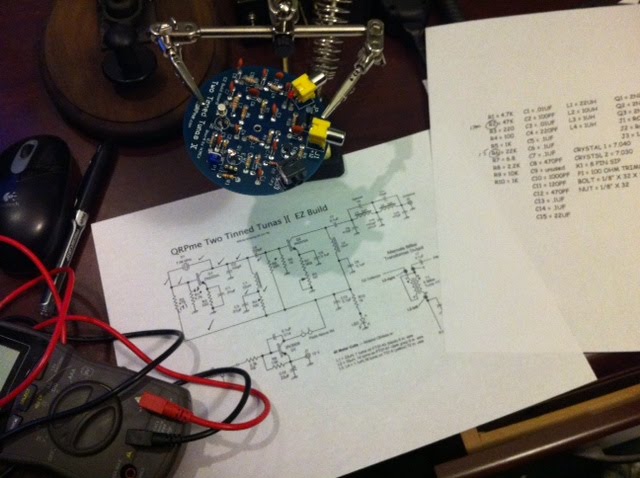
That's a mouthful. This is the second electronics kit that Ben and I worked on together as a father/son project. Our first kit was a robotic crab....some kit I found on a website. The circuit board is cut out in the shape of a crab, has two flashing led eyes, and it runs along the floor toward a light source. We were lucky. It worked the minute we powered it up.

The 2 Tinned Tuna kit was our second attempt. We weren't so lucky this time. We did have a lot of fun. One of us would run the soldering iron, the other the solder. Sometimes Ben would tackle a componet all by himself. We fired up the transmitter recently, feeding into a home-brew dipole cut for 40 meters. Ben used our home Yaesu 857d as a receiver. I sent my call sign on 7.030. Well...we get a strong carrier right on 7.030, but instead of a nice CW tone, we get a harsh, buzzing sound. I was bummed, and Ben was ......well....."Dad I told you this thing wasn't going to work". Maybe it was the tuna fish tin and label that took away his faith. For me, it was part of the Maine charm of this kit.

I inspected each of the soldering joints; they all looked fine. I check our compoents to ensure we installed them correctly. Finally, I traced the circuit with a multi-tester and everything seems in order. It's not going to be that easy, I see. I was able to get the original Tuna Transmitter article by the late Doug DeMaw form the QST Archives, www.arrl.org . While have a build that's not working is not 'great', I can see the fun associated with the whole process. The design from my kit has evolved since the original 1976 article, DeMaw does list DC and radio frequency RMS voltages on his schematic. So.....now to build an RF probe and dummy load.....

Sunday, December 26, 2010

QRP in Blizzard Conditions


QRP contact for tonight was with Lou, K3OXG in Pennsylvania. This was especially neat as we currently have blizzard conditions with 12" snow, 40 mph winds, 22 degrees outside. I was out shoveling earlier, and was amazed at how the ladder line dipole is dancing up in the trees. I took time to loosed the support ties today in the hope of preventing a break under stress tonight. I bet the ladder feed line is bouncing up and down over 10 feet.

Using 5 watts to the dipole, we were able to complete the contact. There was quite a bit of QSB, so I appreciate Lou's efforts with my code and pulling my signal out of the wind.

Saturday, December 11, 2010

Dual-Band Inverted-L Antenna


Great day! I finally had an opportunity to transform my old inverted-L antenna using an article by Dennis Monticelli, AE6C from the QSO, July 1991 article ""A simple, effective dual-band inverted-L antenna" for 160 and 80 m. I found this article in the compendium ARRL's Wire Antenna Classics, pp. 7-13 to 7-16.

This variation uses a 3/8 wave-length wire....192 feet total for the radiator. This antenna is suspended (carefully) in a huge old oak tree out back. The distance from the shack is a total of 150 feet, so my first step was to upgrade coax to RG-213U. I preserved the existing two ~ 130 foot radials, and added two additional ~ 190 foot radials. About 70 feet of the radiating element is suspended vertically by the oak, and the remaining 120 feet sloops down to the back of my house an onto the balcony off our second floor. I had hoped to 'launch' a new wire over the house, but my son lost our sling-shot, and I had no suitable potato for the potato canon (life is difficult here :)

I had planned to hook up the antenna analyzer and evaluate resonance with and without the 100 to 400 pf capacitors placed in series with the feed line...as described in the original article. Well, it snowed last night, was cold, and the sun was setting fast (I'm whining). I hope to get to this done down the road.

A tuner and current choke sit at the base of the antenna, pictured above. Current choke is at top, MFJ remote auto-tuner turned on side in the middle, and a copper pipe terminal for the radials at bottom. Instead of home-brewing a matching system as described by AE6C in his 1991 article, I cheated by using the MFJ-927 remote auto-tuner at the base of the antenna. I also installed a DX Enginneering Feedline Current Choke. Hey, the antenna is precariously close the neighbors...I can't affort any type of feedline radiation / RF interference.

The new antenna tuned up nicely on 160, 80, and 40m. I was anxious to make a contact on 160. I was calling CQ for the SKCC weekend sprint. Richard, K2ZR was quick to answer my call and was patient with my ~12 wpm morse code. After the contact, I realized I hadn't increased my power above the 5 watt maximum for tuning!

So, new antenna, and the first contact on 160m was QRP to boot. A great day at N1Dn.